
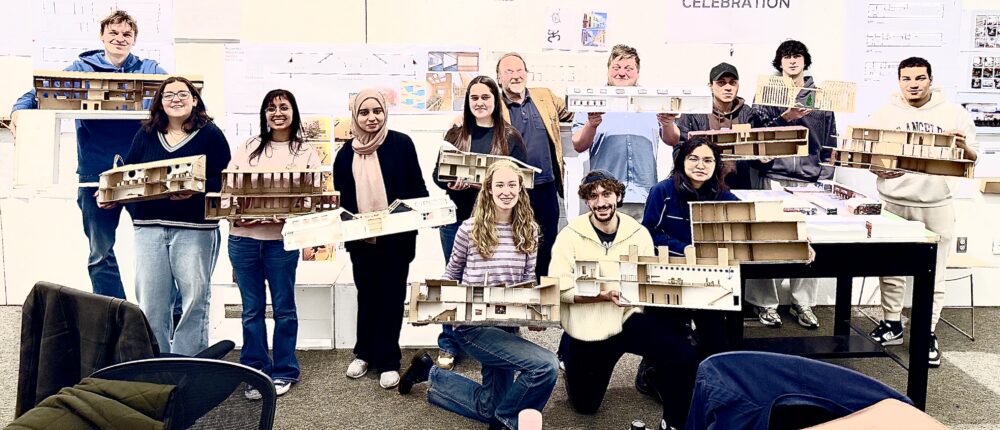
What I Learn From Teaching Architecture
I have been asked to teach architecture several times over the past 40 years. I can do this without academic credentials, other than the enhanced bachelor’s degree of a BArch, because I’m fully enmeshed in doing the very things students are learning: I am an architect.
In recent years I’ve taught at the University of Hartford as an adjunct professor, one course a year. It’s been immensely rewarding, especially now as I’m older than during my previous educational forays. Almost four decades ago I was asked to teach first-year design and writing at Roger Williams University, but after a couple of years building my practice halted that. A bit later I was asked to pinch-hit for a year at Yale. Both architecture programs were great and had terrific students, but I was in my 30s, deep in midcareer creation, and had not yet realized the full cornucopia of the profession’s banquet of experiences.
Being asked to teach is an honor for any practicing architect, fraught with all the joys and subjectivity of personal experience. While academics can define anything in a book or a database and give it proper context, only the player knows what it’s like to play the game. Adjuncts use the experience of their life’s mission as a body of knowledge to be shared.
As an adjunct, I do not advocate a canon, formula, or aesthetic cause. I don’t preach. Instead, I try to connect with people, sites, and technologies. Listening is the only absolute requirement for connecting. Traditionally, teaching was one-way listening: lecturing professors and passive students. I cannot teach that way. I have to teach with students, in dialogue more than in direction.
Students in their late teens and early 20s are largely ignorant, often wildly devoted, but universally terrified of being discovered as imposters. So I embrace their fear and incompetence in our first classes, revealing the feet of clay that I, too, walk on, starting with an Ivy League education that in 1973 included a faculty that was 100% white and male. I then ask each student where they are in life and what they think their goal is: design, construction, art, etc.
My students are an inspiration…They’re the essence of desire finding a path to expression.
My Hartford students are an inspiration—majority female, majority minority, mostly commuters with active employment to pay for school. They’re the essence of desire finding a path to expression. I have been down that path: I show them my experience, without prescription, sharing my own failures in school.
After architecture school, I was a high school football coach for seven years. In teaching, I’ve learned that the fears my players had are the same ones my students have. In these early years, architecture students care deeply, without understanding or calculation. They don’t have the confidence earned from actual achievement, so I say to them, “I have to grade you. But I will never, ever fail you. Because you can only fail yourself. This is up to you. Everyone learns far, far more from failure than from success.” Their eyes are wide when a professor puts the responsibility for growth in their hands, where it belongs.
I try not to direct, suggest, or alter designs without first saying, “This is me. You have to find you.” There are errors and the vast ignorances of youth, so I help with knowledge gaps—including my own. We come from wildly different worlds: I am a 70-year-old straight white male, privately schooled, football-devoted, unreservedly Christian. I let them know that these things are me; then I ask, “Show me you,” and listen to them.
Of course, there are bad choices of timing, priorities, and distractions, along with the complexities of home life in a school context, of often seeing architecture as a distant object of digital fantasy. I try to change their world while conveying mine. I show them how architects see the world, using writings and images and virtual sessions with architects in other places and offering other perspectives. We visit project sites. These exercises are not academic or professorial, but a form of connection. And that connection between educator and student is the guileless sharing between radically different demographics and stages of life. Even though my design section has a robust workload, students (who choose their professors) opt for a harder studio, because they see the results of that connection.
As the years go by, students from previous classes know they can connect with me because, as I repeatedly say, architecture is fundamentally human. And that humanity is not just those who are living; it’s all those who came before us, all those who will live with our designs in the decades to come. So I quote Henry David Thoreau from Walden Pond: “If you have built castles in the air, your work need not be lost; that is where they should be. Now put the foundations under them.”
I may feel like I am the 16-year-old who acts in hope, but 50 years of thinking and making changes one. So why teach? For the engaged professor, teaching is a course on our shared humanity. If teaching and learning happen at the same time between the teacher and the student, then everyone’s perspective widens. The wider my vision, the more I see, the more I can know what can be seen. Connection is not direction or creation, but it leads to both, if we just listen.
Featured image courtesy of the author.