
Why Disband the Urban Design Group Just as New York City Ramps Up Housing Development?
As Mayor-elect Zohran Mamdani prepared to move out of his rent-stabilized apartment and into Gracie Mansion, he waxed poetic about his neighborhood in Astoria, praising its vibrancy, its diversity, and, of course, the abundance of great food. “Time and again, this community has shown up for one another—the endless Adeni chai, the spirited conversations in Spanish, Arabic, and every language in between, the aromas of seafood and shawarma drifting down the block,” Mamdani told a gaggle of reporters. “While I may no longer live in Astoria, Astoria will always live inside me and the work I do.”
Clearly, these are the sentiments of a New Yorker who understands that great neighborhoods are the lifeblood of the city. But what makes them great? It starts with good urban design. But as Mayor Mamdani prepares to appoint a new director of the Department of City Planning (DCP), a decision that was set in motion before he took office deserves reconsideration: the abrupt disbanding of DCP’s Urban Design Division and disbursement of individual designers across agencies and the five boroughs.
Weakening an Asset
The city’s most recent neighborhood plans that are creating new mixed-use, mixed-income communities include the Gowanus redevelopment in Brooklyn, the OneLIC Neighborhood Plan in Queens, the Spofford redevelopment project in the Bronx, as well as the rethinking of Staten Island’s North Shore project, to name a few.
They are a direct result of a comprehensive planning and design collaboration that considers all of the interdependent components of an urban ecosystem—components that should not benefit just the wealthy. These are the places with access to public space (such as waterfronts and parks), walkable streets, local retail and flexible workspaces, schools and libraries, and permanently affordable housing. The Urban Design Division has been critical to operationalizing this urban planning shift over the last 20 years, applying it not just to large-scale neighborhood plans but also to long-neglected public spaces within and around New York City Housing Authority (NYCHA) campuses.

Dismantling the close collaboration between urban planning and design will undoubtedly weaken one of the city’s most effective institutional assets at precisely the moment when New York needs visionary, coordinated design leadership to deliver on ambitious goals for affordable, dignified housing that only succeeds when it’s rooted in economically and culturally vibrant, inclusive neighborhoods.
Developers Chafe at Design Oversight?
It’s not clear why the outgoing Adams’ administration took this step at the 11th hour. Some have speculated it came at the behest of developers who object to design oversight—a complaint that goes all the way back to the Bloomberg administration.
Others have suggested, more charitably, that the intent might have been to bring urban designers closer to projects within boroughs and agencies. On paper, this argument might seem aligned with a community-oriented ethos. But every borough already has at least one embedded urban designer who serves as a liaison to the centralized Urban Design Division. In other words, the evolution of community-oriented design pioneered at DCP is the result of a both/and approach.
The Urban Design Division works closely with planners at DCP as projects evolve, as well as with the urban design liaison(s) in the borough where the development takes shape. Urban planning sets the rules of the road, but urban design is the creative force that tests, refines, and humanizes it. This only works when people are collaborating in close proximity to each other in real time and in the same space where decisions are being made.
Decoupling urban designers from DCP risks turning urban design into an add-on support service rather than a strategic partner. It weakens the “yin-yang” dynamic that has enabled the department to move beyond technocratic compliance. This would be a huge step backward at a time when the vestiges of 20th century zoning have come under scrutiny for stifling housing production and making it all but impossible to build mixed-use, mixed-income communities.
Punching Above Its Weight
There is also a citywide governance dimension that needs further consideration. DCP’s Urban Design Division has long served as a critical resource for agencies such as NYCHA, the Economic Development Corporation, and the Department of Design and Construction—entities responsible for some of the most consequential development projects in New York, from affordable housing to civic buildings to major infrastructure investments. A dispersed model raises real questions about consistency, coordination, and the city’s ability to provide the same standards across all five boroughs.
The Urban Design Division is not large. But as a centralized, collaborative team, it has consistently punched above its weight. Its value lies not only in individual talent, but in collective practice: shared critique, internal debate, and a long view of how neighborhoods evolve over decades, not election cycles.
New York does not suffer from a lack of plans. It suffers when plans fail to translate into places that people love. Dismantling one of the few structures designed to bridge policy and lived experience would be a costly mistake. The incoming director of city planning would be wise to rethink this abrupt change and align DCP with Mayor Mamdani’s ambition and vision for a more affordable, equitable, and livable city.
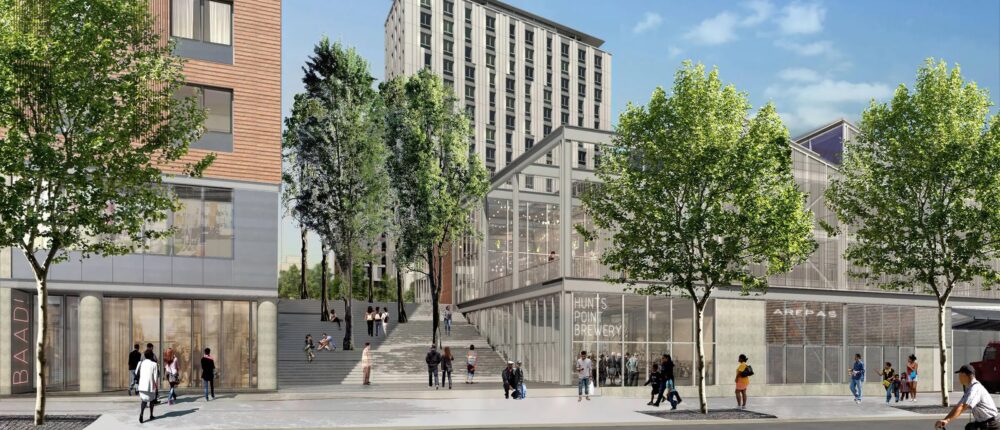
Featured image: The Peninsula in Hunts Point, Bronx, is a massive 100% affordable, five-building mixed-use project transforming the former Spofford Juvenile Detention Center into 740 permanently affordable homes. Image courtesy of Body Lawson Associates.