
With Federal Dollars, Sunnyside Yards Might Just Happen This Time
The idea of redeveloping the 140-plus acres of rail yards in Queens, New York, has been kicking around for decades. The structural challenge and enormous cost of spanning over rail tracks has been the death of other projects, such as Atlantic Yards in Brooklyn, especially if the proposed redevelopment is meant to include affordable housing and other social amenities, rather than just luxury housing and offices, like Hudson Yards. Mayor Zohran Mamdani’s trip to the White House and his pitch to President Trump to fund the $21 billion cost of decking over the yards has revived interest in the project.
The name “Sunnyside” originated around 1710, when French Huguenots purchased the land and named it “Sunnyside Hill.” After the consolidation of New York City into the five boroughs in 1898, the area began to be developed. Between 1903 and 1905, the Pennsylvania Railroad Company purchased almost 200 acres in the area, much of it tidal marshland.
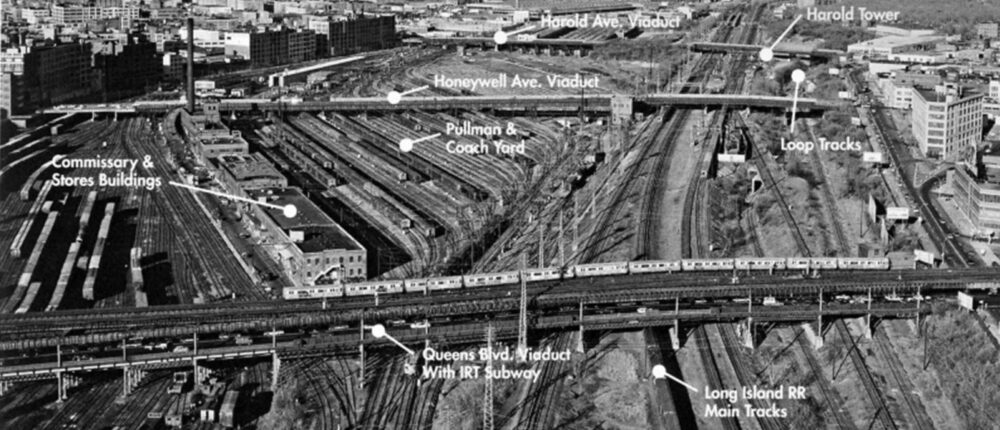
Sunnyside Yards as we now know it was created as part of the massive Pennsylvania Railroad project to connect New Jersey to Long Island City through tunnels under the East River that led to Penn Station. At its opening in 1910, the yards occupied 192 acres and contained more than 25 miles of track, storage, and cleaning facilities for the trains. It was the largest such rail infrastructure on earth and could accommodate 1,000 railcars. The surrounding neighborhood was mostly industrial, with the American Chicle factory, Sunshine Biscuits, and a Macy’s warehouse among the uses. By 1914, most of the wetland and marsh had been drained and filled or covered.
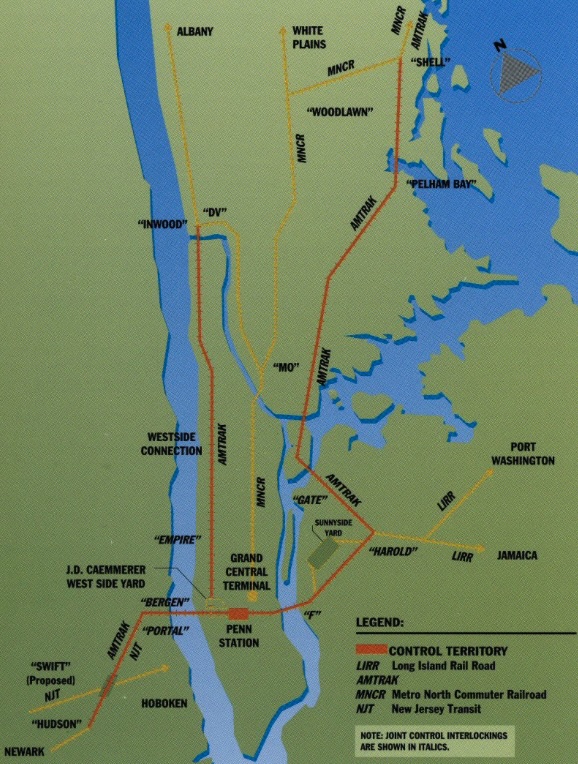
Between the 1950s and 1960s, as highway construction increased and air travel began, Pennsylvania Railroad’s business declined. The company and its competitor, the Central Railroad Company, combined in 1966 to form the Pennsylvania Central Transportation Company. However, the new entity also failed to thrive and went into bankruptcy in 1970. New York State took the Long Island Rail Road into state ownership. Pennsylvania Central was divided up into passenger (which became Amtrak) and freight (which became Conrail). Today, the yards continue to handle freight operations for several railroad companies, as well as storage and maintenance work for Amtrak. In 2012, the Department of Environmental Conservation designated the site a Superfund site due to the need to clean up heavy metal contamination in the soil.
There have been several proposals over the decades to develop the yards. As the surrounding Queens neighborhood became more residential, the development of the yards stood out as an opportunity to more closely incorporate those 190 acres into the borough. Robert Moses had his eye on the site as a possible route for the Long Island Expressway, but even he was daunted by the difficulty of decking over an active railyard. In 1931, the Regional Plan Association proposed a major redevelopment of the area, including decking over the rail tracks. In the 1960s, a major sports complex was proposed but ultimately sited at the Meadowlands in New Jersey. During the Bloomberg administration, Sunnyside was proposed for an “Olympic Village” as part of the city’s bid for the 2014 Olympic Games. In 2015, the de Blasio administration proposed developing 1,000 housing units at Sunnyside, a plan that did not come to fruition.
Most of the earlier proposals for Sunnyside addressed the structural problem by installing foundations at specific points between the tracks and then building tall buildings on them. The problem with this solution is that, in addition to having to bear the cost of the deck structure, the resulting buildings would be out of scale with the surrounding Queens neighborhood, and the creation of streets and public open spaces tends to be an afterthought, dictated more by structural requirements than by urban planning.
In 2020, New York City’s Economic Development Corporation brought in the urban planning team led by the Practice for Architecture and Urbanism (PAU) to look at a different approach. Instead of plopping foundations for buildings between the tracks, the proposed structural solution was to separate the support for the deck from the support for the buildings and other structures on top.
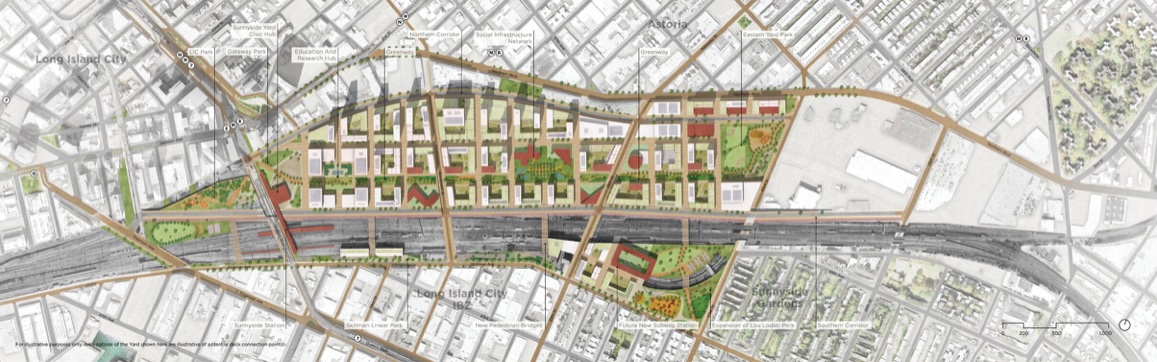
In other words, a deck structure would be built over the tracks, but the buildings could be located where it made sense and not just determined by the need to locate foundations in specific places between the tracks. This liberated the planning of the site from the limitations on where buildings could be built to planning for a holistic neighborhood, regardless of the foundation question. As the plan states: “The resulting decking strategy can support a wide range of building types and locations, enabling the Master Plan to respond to the community engagement process and preserve flexibility for future needs.”
As the Danish urbanist Jan Gehl famously quipped, “First life, then spaces, then buildings; the other way around never works.” The PAU team was able to focus on what an extension of Queens into the yards could look like. What kind of neighborhood should it be? Wisely, they focused on the public realm rather than simply siting buildings.
In the PAU plan, new streets extend the existing street grid, providing continuity between the old and new. Attention is paid to the quality of the street, with priority given to pedestrians and biking. Public open space is plentiful. Importantly, much of the final form of buildings is left to future decisions, allowing a more organic development rather than a predetermined plan.
As the plan states, “The resulting plan answers six pressing ‘needs’ identified during the outreach process: creating open space and social infrastructure like schools, libraries and clinics; improving transportation and mobility; building truly affordable housing; creating workforce development opportunities; setting new green building standards; and perhaps most importantly, ‘keeping it Queens.’”
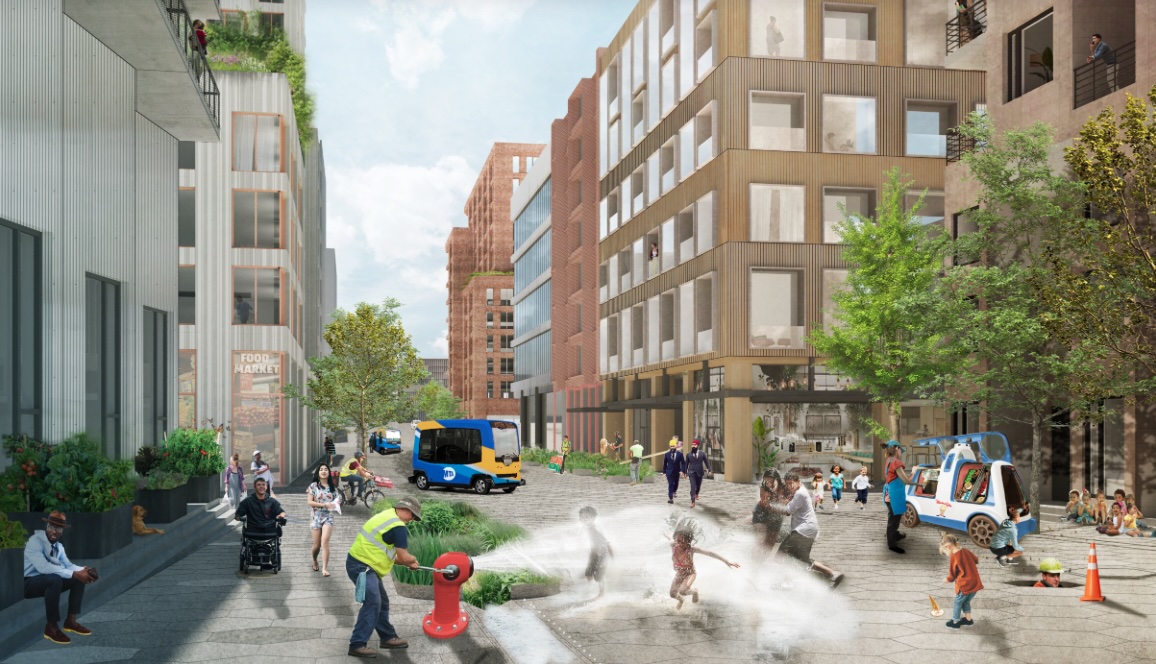
As most planners know, planning is a process rather than a single event, so allowing development to take place in phases, responsive to evolving needs, is more likely to succeed than trying to lay down a comprehensive design as a fait accompli. It also allows time for community input on how the site should be developed.
Of course, it is still not without its challenges, including how to get power and water up into the buildings through the deck, and how to drain waste down from the buildings and streets to waste treatment facilities. We all know that the $21 billion price tag for the deck could well be $42 billion by the time it’s finished. Hopefully, the cost of the decking will be borne by federal dollars rather than by whatever is built on top. (The cost of decking over the Hudson Yards rail tracks meant that the affordable housing that was promised has been dropped from the plan.) But if Mayor Mamdani can secure the $21 billion he is requesting from Trump, there is hope.
One way to reduce the cost of building on the deck is to use mass timber construction. Mass timber replaces traditional steel and concrete construction with wood that is typically laminated to give it strength and achieve longer spans. Mass timber is lighter, cheaper, and more sustainable than traditional steel and concrete, since the latter requires significant energy to produce. The technology of mass timber has developed rapidly over the past decade so that taller buildings are possible.
For example, Portland, Oregon’s Julia West House is a 12-story mass timber apartment building.
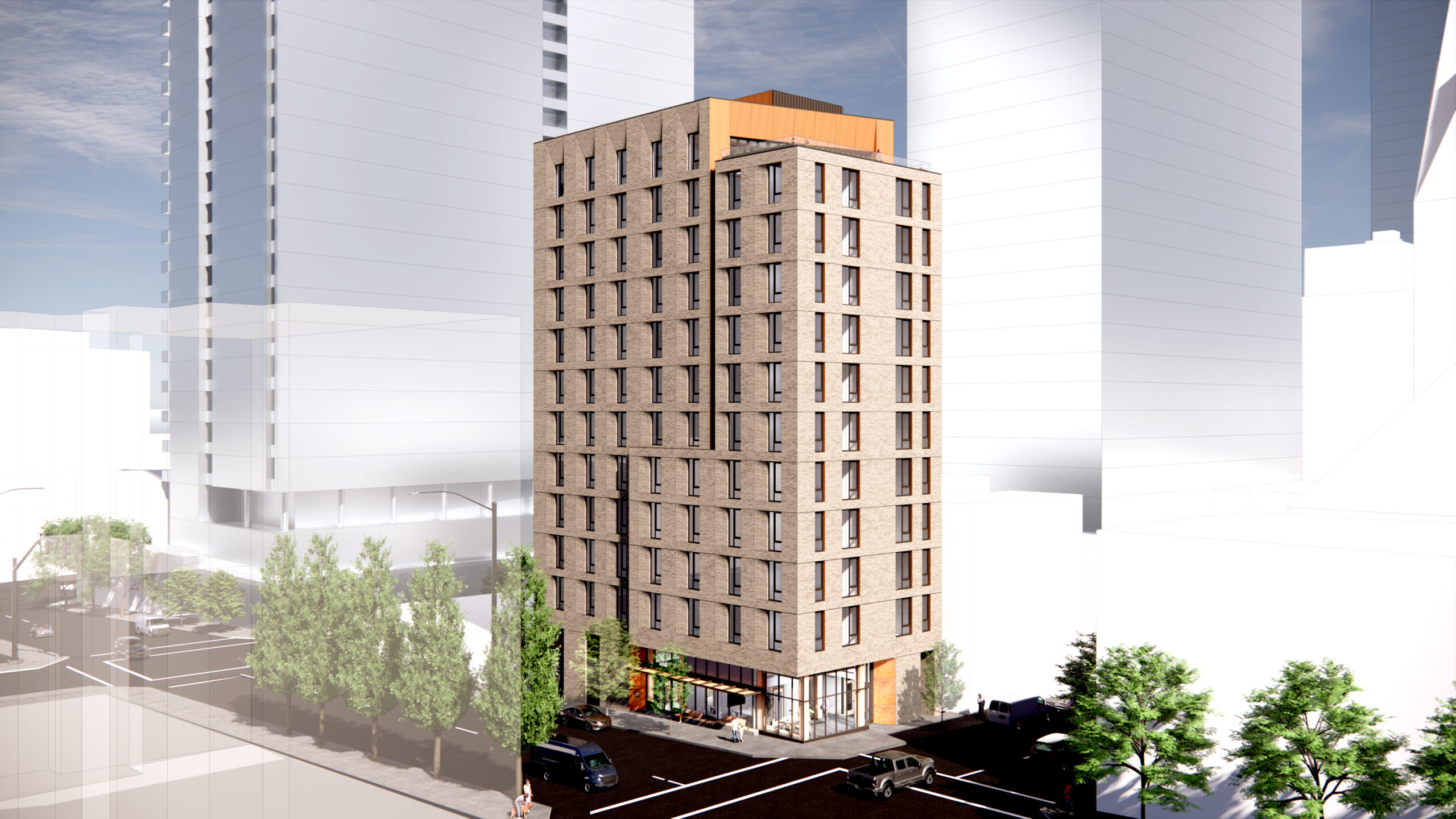 Julia West House rendering via Holst Architecture.
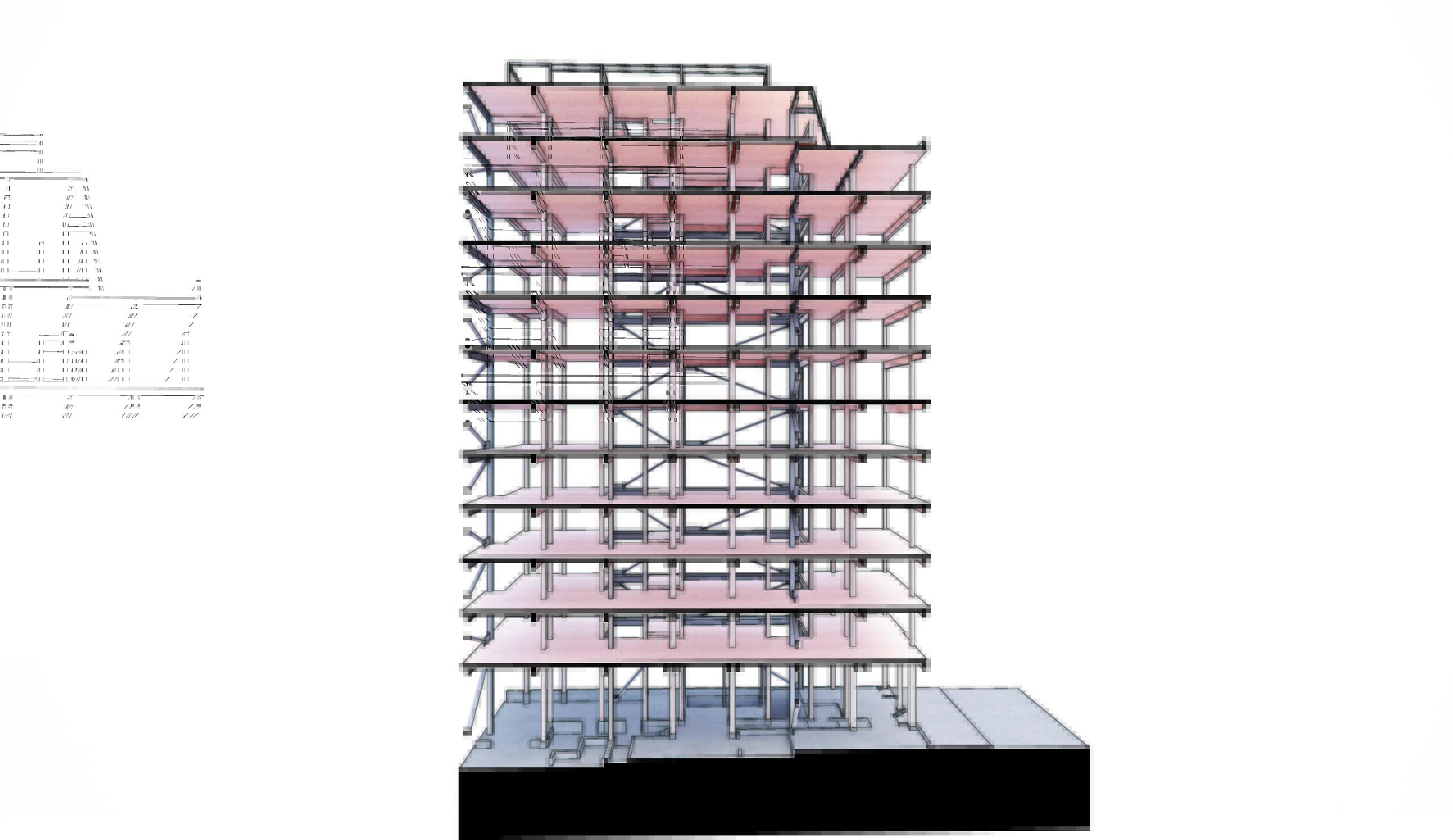
Julia West House, structural section perspective, via Holst Architecture.
Somewhat counterintuitively, wood is not ruled out due to fire risk because the outer layer of wood columns and beams chars quickly, and that charred layer protects the core of the wood long enough to evacuate the building. Steel, on the other hand, buckles quickly in a fire and has to be covered in fire-resistant material.
There are other advantages to mass timber. While steel and concrete prices continue to rise, there is a plentiful stock of white pine in New York State that can be sustainably harvested for construction. This not only lowers the carbon footprint, but also provides jobs for tree harvesting and for workers in the mass timber mills.
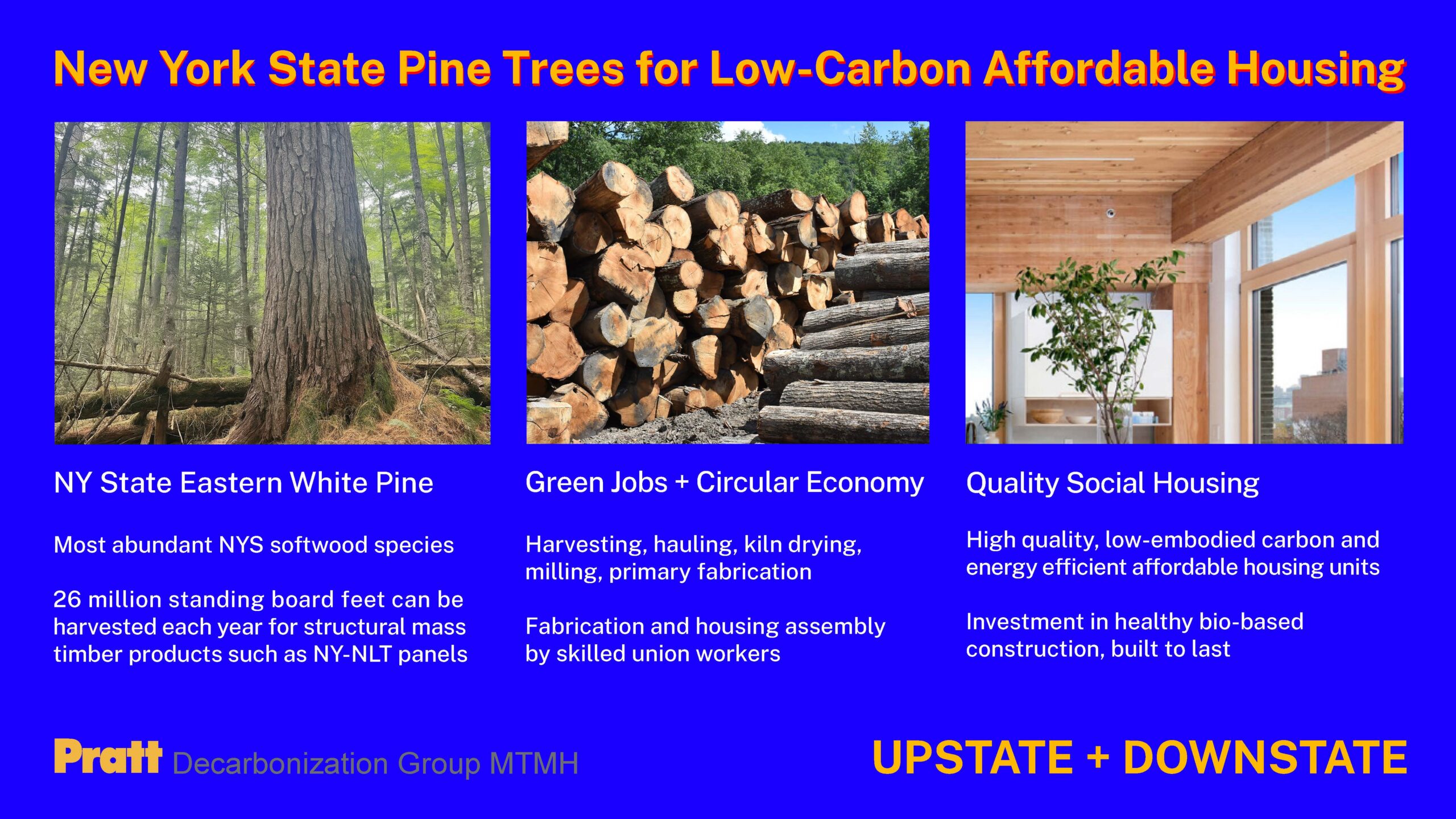
Because mass timber is lighter than steel and concrete, the strength, and thus the cost, of the deck over the rail tracks can be reduced. So perhaps there is hope for this latest plan for Sunnyside Yards. With federal funds to support the cost of the decking, with mass timber construction to reduce the cost of the buildings, and with time to incorporate community input into what is actually built, it might just be the best thing to happen in Queens for a long time.
Featured image: Sunnyside Yards in 1977. Photo by Nick Kalis.