
The Urban Design Legacy of Colin Rowe
From 1955 to 1985, American universities built architectural programs into their curricula at a rate not seen before or since. The U.S. was leading the world in erecting buildings in cities and creating suburbs virtually everywhere. A few of these architecture schools also taught city planning, and fewer still taught urban design. One of the best was Cornell University in Ithaca, New York.
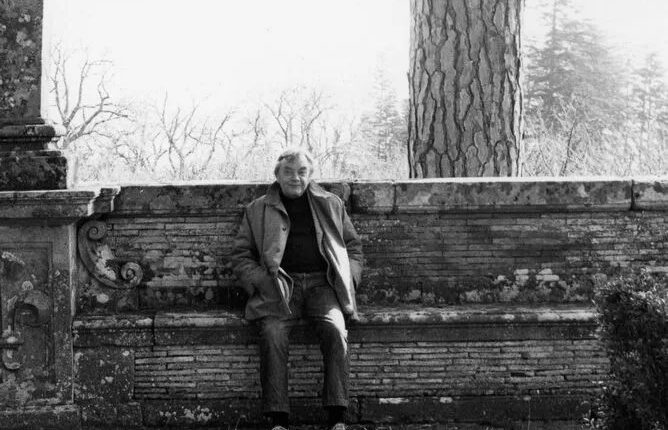
Cornell’s Urban Design Studio was the invention of a professor who went on to become something of a legend among mavens of design theory and practice. Colin Rowe (1920–1999) lived to see the birth of the Modern movement in Europe, its transplantation to America, and its critical unraveling during what was called Postmodernism. He was one of the most important historians and theorists of modern urbanism, and an inspiring teacher who gave many students a boost in both academic and professional careers.
An ambitious new book appeared last fall that will certainly become the ultimate guide to Rowe’s work. The Urban Design Legacy of Colin Rowe, edited by Steven W. Hurtt and James T. Tice, is a massive tome at 682 pages and has been beautifully produced by Gordon Goff at ORO Editions, under its Applied Research + Design imprint. It belongs in the library of every architect and urbanist who wants to understand the history of the built environment during the modern era. My review will address Rowe’s career in two parts, as there is too much material in the book for a standard Common Edge essay. In Part 1, I will reserve my comments to the professor himself; in Part 2 I will review essays by his most important followers.
Rowe was born in the industrial town of Rotherham, near Sheffield, in the English midlands. Trained in an elite grammar school, he went on to study architecture under Charles H. Reilly at Liverpool University, then the leading Beaux-Arts program in Britain. He and a fellow student, Robert Maxwell, designed a department store as their thesis project in 1944, before both went into the army as paratroopers. Their older compatriot James Stirling had taken the same path but was badly wounded during the D-Day invasion.
Rowe received his intellectual education in art history at London’s Warburg Institute from 1945–47, studying mainly under the great Rudolf Wittkower (1901–1971). His studies were not limited to architecture, as Aby Warburg preached a broad, cultural-symbolic view of human creativity. Indeed, although he was not born into the aristocracy, Rowe became the epitome of the English connoisseur. Gimlet-eyed, he observed the upper class in their salons, drawing rooms, and antiques sales, soaking up everything he saw and heard. Still, he was enough of a firebrand to see the sun setting on the Empire, and decided to cross the Atlantic for a look at American art and architecture in 1951 on a Fulbright Fellowship (those essential grants tying Europe to America after the war). He was quickly seduced by New York, the western landscape, and wide-open scholarship in U.S. colleges.
Eventually, Rowe became a fundamentally American critic of the built environment who could take in that environment from a multicultural point of view. His career was in many ways a journey toward pluralism and a multiplicity of philosophical positions and away from Continental rationalistic positivism. Though never a pragmatist per se, he embraced Karl Popper’s views on science and Ernst Cassirer’s on art’s connection to culture.
Following studies at Yale with Josef Albers and Henry-Russell Hitchcock, Rowe made an important stop at the University of Texas in Austin. There he met Robert Slutsky, John Hejduk, Jerry Wells, and Michael Dennis (often called the Texas Rangers), and experienced the strange anti-urbanism of suburbs, courthouse towns, and ranch landscapes. Like any good English explorer, he ventured out into the noonday sun of the Texas Hill Country with nary a complaint, protected by a broad hat.
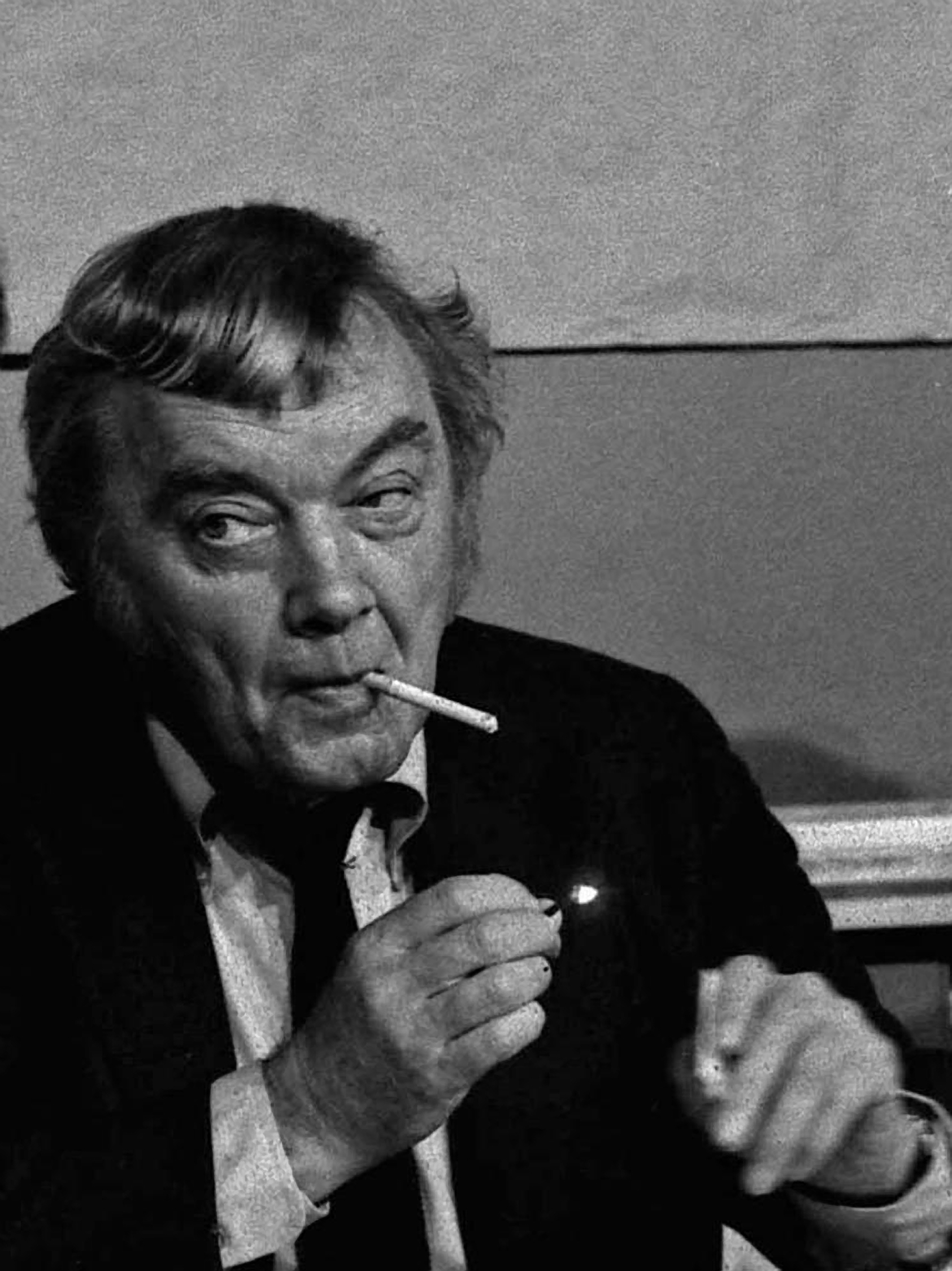
When the dean of Cornell’s architecture school offered him the chance to found a program in urban design, he jumped at the opportunity. John Reps, a professor of urban history there, proposed that the school have a studio specifically on urban design, and Rowe joined with Jerry Wells to create its curriculum and method in 1962. The first conundrum about Rowe has always been: Just what was that method, and why don’t his students agree on what made the work so good? If urban design was going to be a discipline, what were its principles?
One of the outstanding features of this book is the large variety of essays by a host of Rowe’s students and colleagues over many decades, not just the years in which the studio was offered at Cornell (1963–1988). The beautiful graphics that accompany each piece make it easy to follow the products of individual studios and publications, while understanding the influences on those design projects. Without a large publication budget, as well as many years of careful editing, a book of this kind would not be possible. Kudos to the editors for their painstaking work.
In the opening section, on urbanism, several key analyses of Rowe’s theory of the “city of modern architecture,” and subsequent critiques of its variants, stand out. Michael Dennis leads the way with “Colin Rowe: The Rediscovery of the City,” a succinct presentation of the lessons of Rome, the Nolli figure-ground map, and the first studies of the traditional city undertaken at Cornell in the 1960s. Steven K. Peterson takes the reader through a “case history” of Rowe’s unusual sleuthing process. Who was the culprit that stole beautiful streets, squares, and urban monuments from the design of cities during the rise of Modernism in Europe? (Hint: His name was derived from the French word for “crow.”) He then goes on to describe a few of the many steps used in a typical studio to move from precedents to formal analysis, to type, to transparency, to figure-ground mapping, to context, and, finally, to urban design.
In a brilliant and witty excursus on “Type and Transformation,” Tice invites us to play a typical Rowe mind game that limbered up his students for the rigors of pluralistic design. Charles Graves writes intelligently about how the Gestalt concept of unitary perception spurred Rowe to use figure-ground drawings in the studio. In all of the opening essays, one feels the weight and significance of history, the fundamental ground upon which Rowe based his theory and pedagogy. Rowe surmised, without recourse to neuroscience, that nothing in the imagination was “original,” but that all innovation came from a knowledge of previous work by respected master designers: History is prologue as well as projection.
The key essays that guide the reader toward Rowe as an urbanist are Antonio Pietro Latini’s “From ‘Mathematics’ to ‘Urbanistics’” and Tice’s “Three Stage Sets in Search of a City: An American Perspective.” In the former, Latini traces in great detail the literature that would undoubtedly influence the younger Rowe as he composed his first essays, including “The Mathematics of the Ideal Villa” while still studying with Wittkower. After the 1960s, Rowe became more focused on collage, texture, and collision than on ideal Platonic geometry, and he studied Rome in great detail through the 1748 Pianta di Roma, by Giambattista Nolli. Bringing in an Italian concept, urbanistics, Latini suggests persuasively that the professor found a kind of refuge in the map from the stark realities of urban renewal and utopian planning during the 1970s and 1980s. He seems to have embraced a softer view of civic ambientissimo in the vein of Gustavo Giovannoni, the forgotten Italian architect known for restoring urban quarters, and grew to appreciate the paesaggio, or landscape, of Italian towns. Rowe led many studios in Rome for Notre Dame, Cornell, and other programs through the decades.
Tice also invokes the Italian sprezzatura sensibility when he discusses the Renaissance penchant for festivals, rituals, and stage performances. In a clever twist, he uses each of Sebastiano Serlio’s prototypical stage sets—comic, tragic, rustic/satyric—to explain a fundamental trope in American urbanism: Main Street, State Street, Elm Street. I found it a stretch to compare New York’s 1930s buzzing metropolis to a tragic state set; what about the Rockettes and their comedic kicks? However, I believe that Rowe and his students pushed hard to find ways to accommodate an urban vision to the myriad of grids, textures, scales, and transportation arteries they found in Buffalo, Manhattan, and other American cities. They were certainly cribbing from everything, from Currier & Ives prints to panoramas of Chicago’s White City, in search of fodder for their collages.
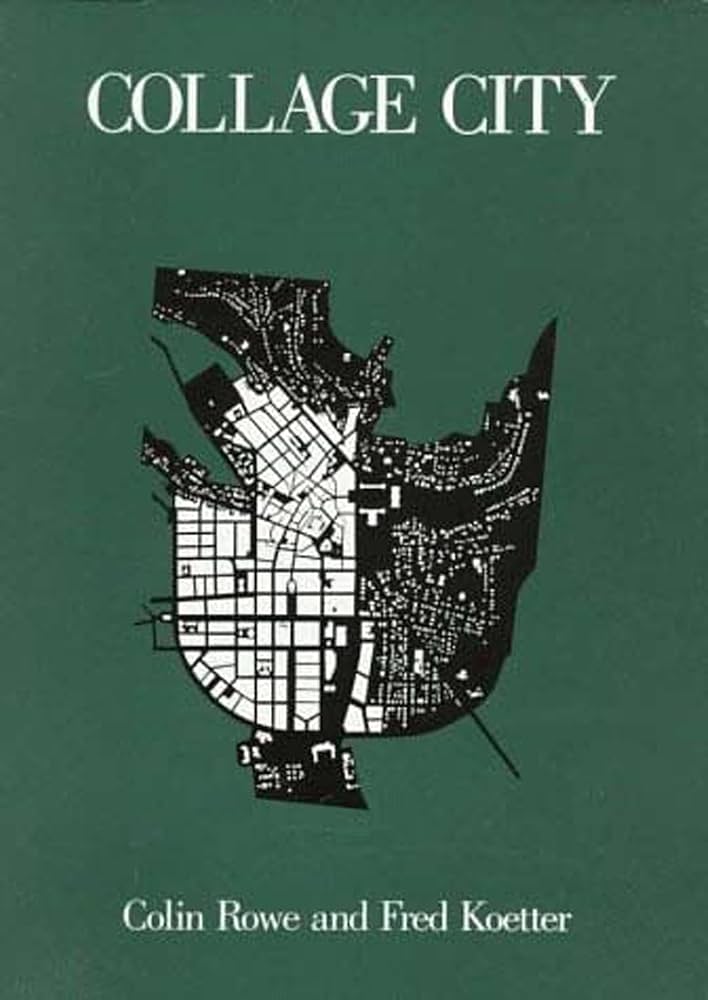
Though one waits until later chapters to trace its conception, tortured production, and publication, Collage City hovers over everything Rowe and his students did at Cornell. He famously was too compulsive to declare anything finished, including his students’ projects, but Fred Koetter dragged his mentor across the finish line in 1975 to publish a real book, Collage City, to explain some of his urbanistic theories and ideas. In it fans could finally trace the pearls of wisdom and scathing critical attacks that were coming from Rowe’s lectures and seminars. It was a bit like listening to bootleg tapes from Bob Dylan or the Grateful Dead—an exciting event for all of us young Turks who wanted to bring down orthodox, corporate Modernism.
Hurtt and Tice provide as much scholarly research as can be had for anyone who needs to know exactly how Koetter and Rowe decided that collage was an appropriate modern technique for introducing the kind of texture and spatial coherence into the broken detritus of modern cities that they believed would heal the wounds of 20th century development. When my fellow students and I read the book in the late 1970s, I think we cared less about the cure than the diagnosis; we wanted fixes, and this was a persuasive alternative to Aldo Rossi’s city as architecture, Venturi and Scott Brown’s Main Street as a pattern of activities, and Henry Hope Reed’s traditional city beautiful. We definitely did not want the Ville Radieuse or Brasilia.
Colin Rowe was the leader of a Postmodern platoon of young urbanists who saw a way out of the wilderness of Harvard/Bauhaus planning. Stay tuned for what they thought about his teaching style, and how they advanced his theories into the twenty-first century in the essay to come.
Featured image via Critical Thinking. All other images courtesy of ORO Editions/Applied Research + Design.